
Make AI part of your research, grounded in your own knowledge.
Abstract
Catamaran is a research workspace built on claims. It breaks the papers you read, along with the notes and conversations you keep alongside them, into structured claims, each tied to its page and exact quote, and it grounds every AI suggestion in that corpus. This note covers what we are building, why we think the unit is the claim, and how to join the private beta.
1. The atomic unit is the claim.
When you read a paper carefully, what stays with you isn’t the whole document; it’s a handful of specific claims. One paper claims that folding stability degrades below MSA-64 CLM-104; a clinical trial claims its intervention lowered the primary endpoint by twelve percent CLM-231. Each claim has a subject, a predicate, a context, and a source, so you can argue with it in a way you can’t argue with a paragraph.
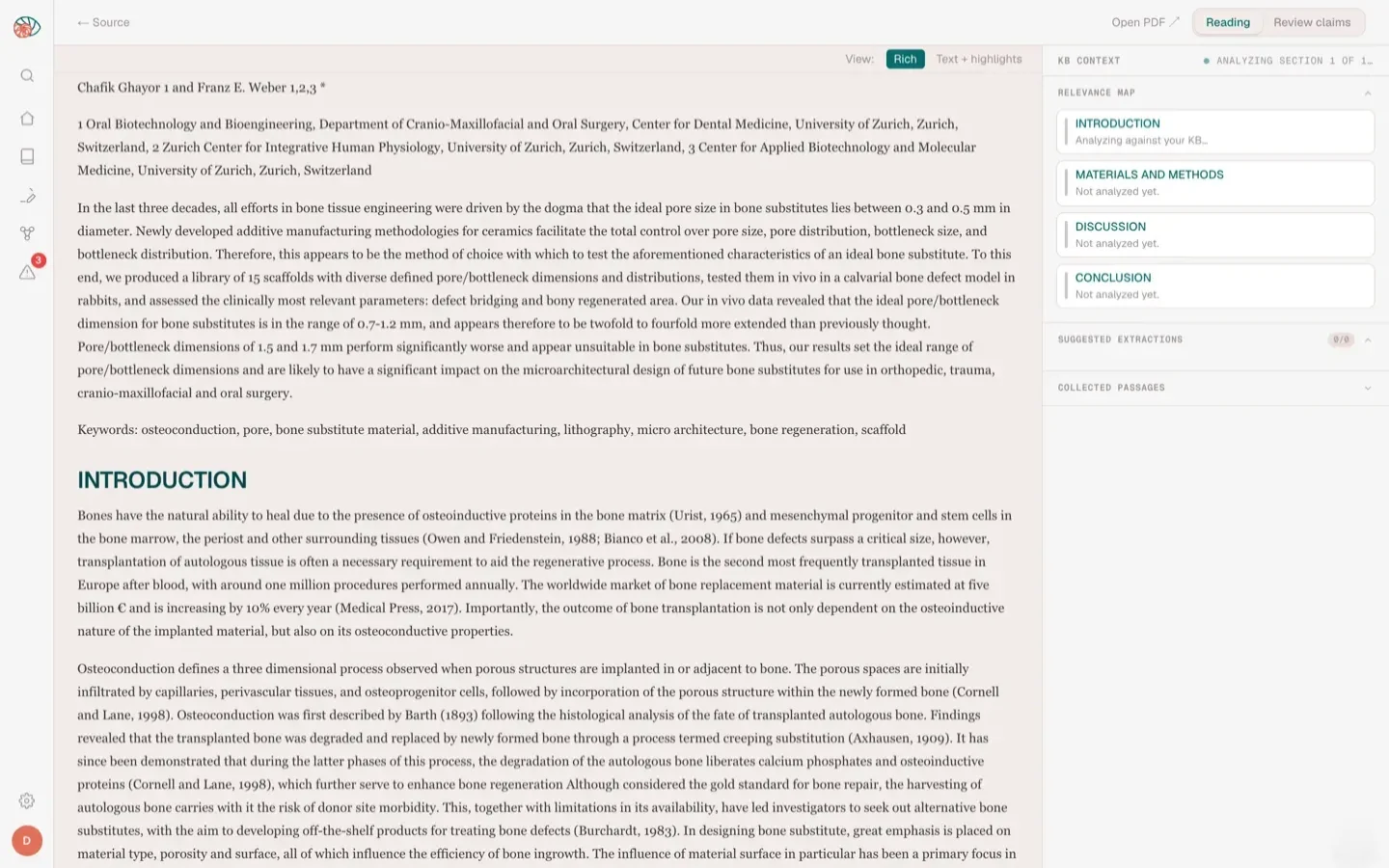
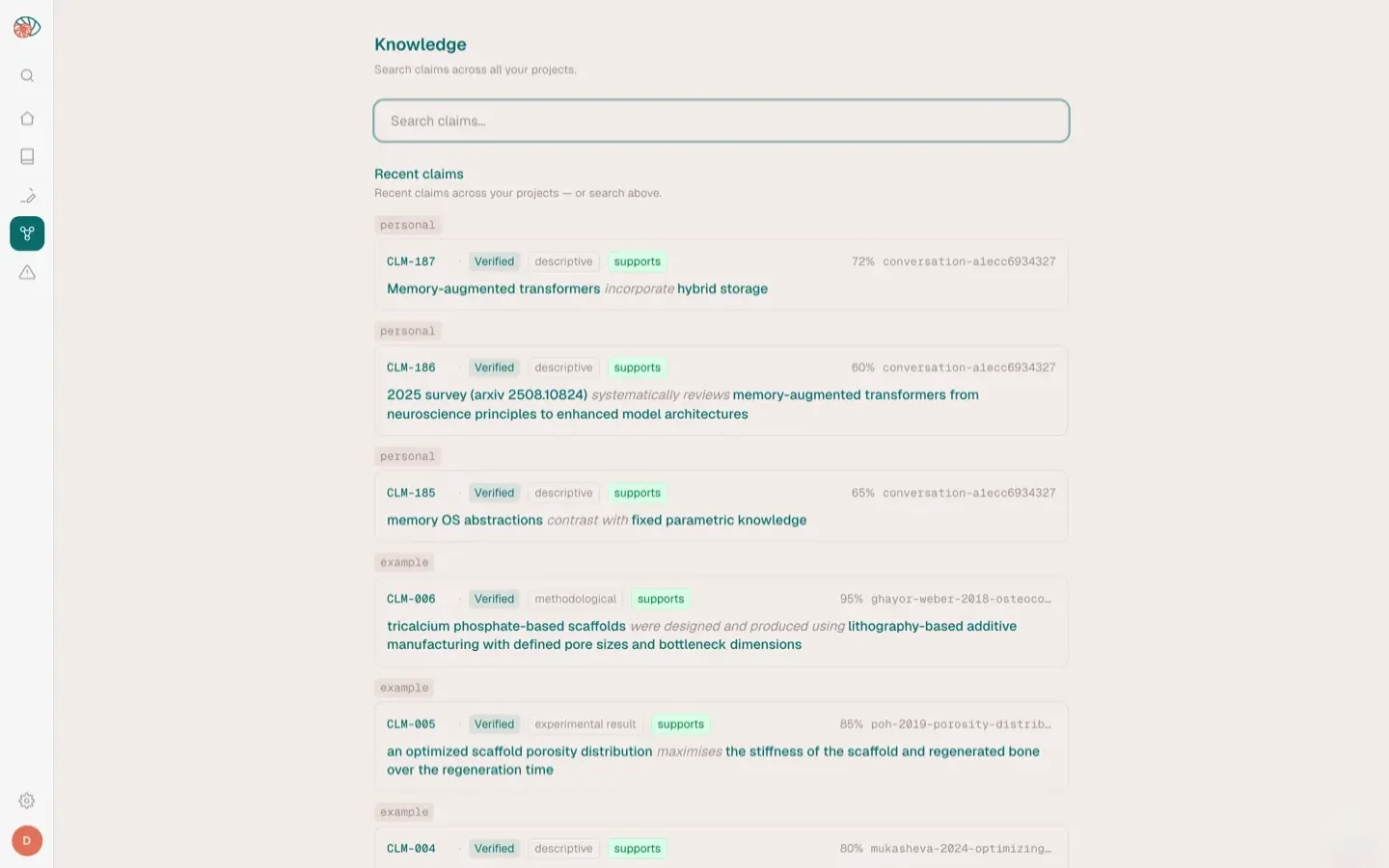
Catamaran takes that idea seriously as a data model. Add a paper and it extracts structured claims with full provenance: the page, the exact quote, and an extraction-confidence score. The claims it finds land in your knowledge base, where you verify, refine, or set them aside; as you read, it proposes new claims and connections to what you already have, and those stay proposals until you accept them. Your knowledge base grows one claim at a time, and you can audit every one.
2. Try it. Highlight a sentence.
Below is a working miniature of the claim model. Select any underlined sentence, by dragging, clicking, or pressing Enter on it, and watch it become a claim in the live knowledge base. In the product this happens at scale; Catamaran does the highlighting for you, paper by paper, and the claims it finds land in your knowledge base for you to curate.
3. Writing, grounded.
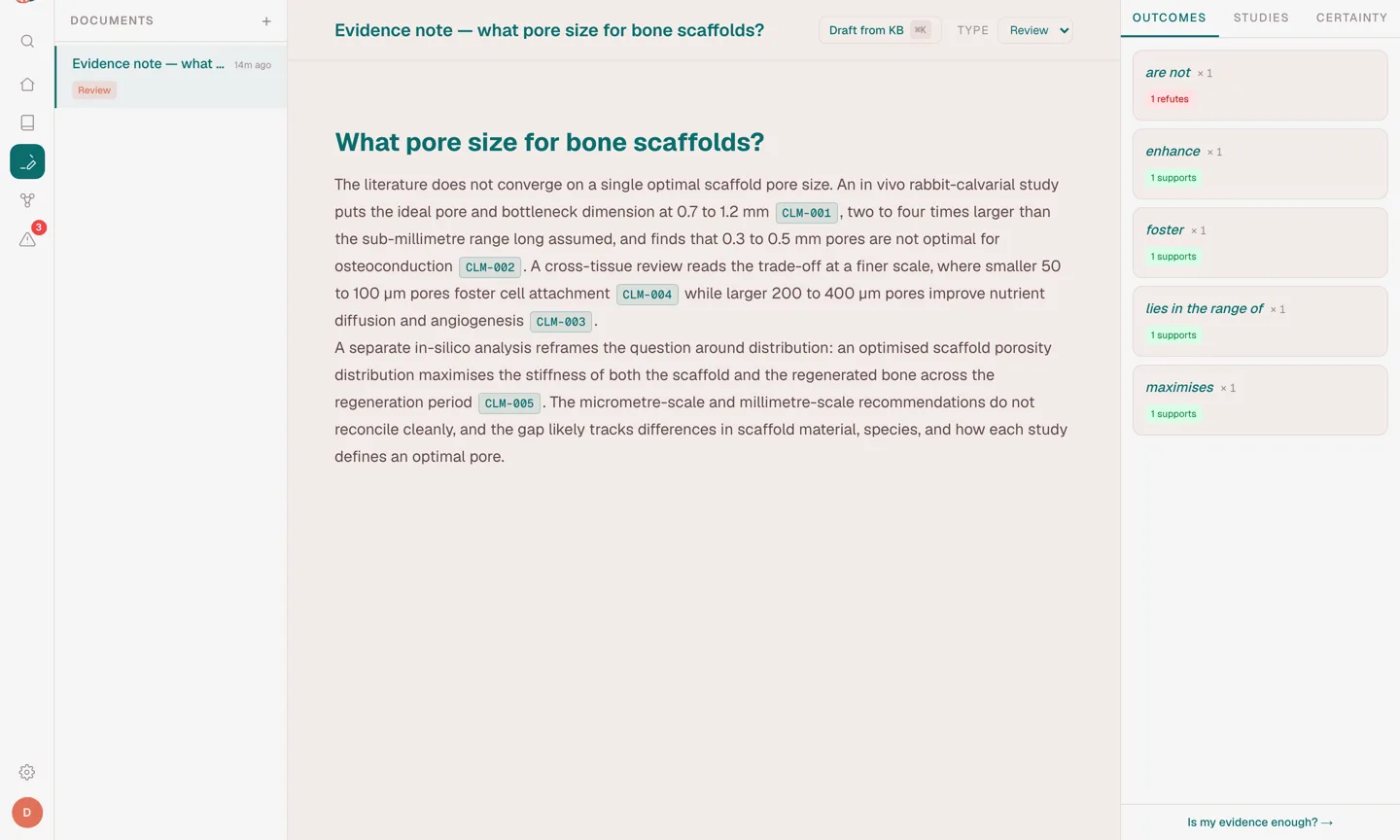
The editor sees only your claims. When the AI suggests a sentence, that sentence is grounded against your own claims like CLM-104, so its only raw material is knowledge you have already accepted. Ghost-text suggestions appear inline and stay ghosts until you accept them.
The result is unglamorous; the AI sounds like you, because it can only say things you already know.
4. Conflict is a feature.
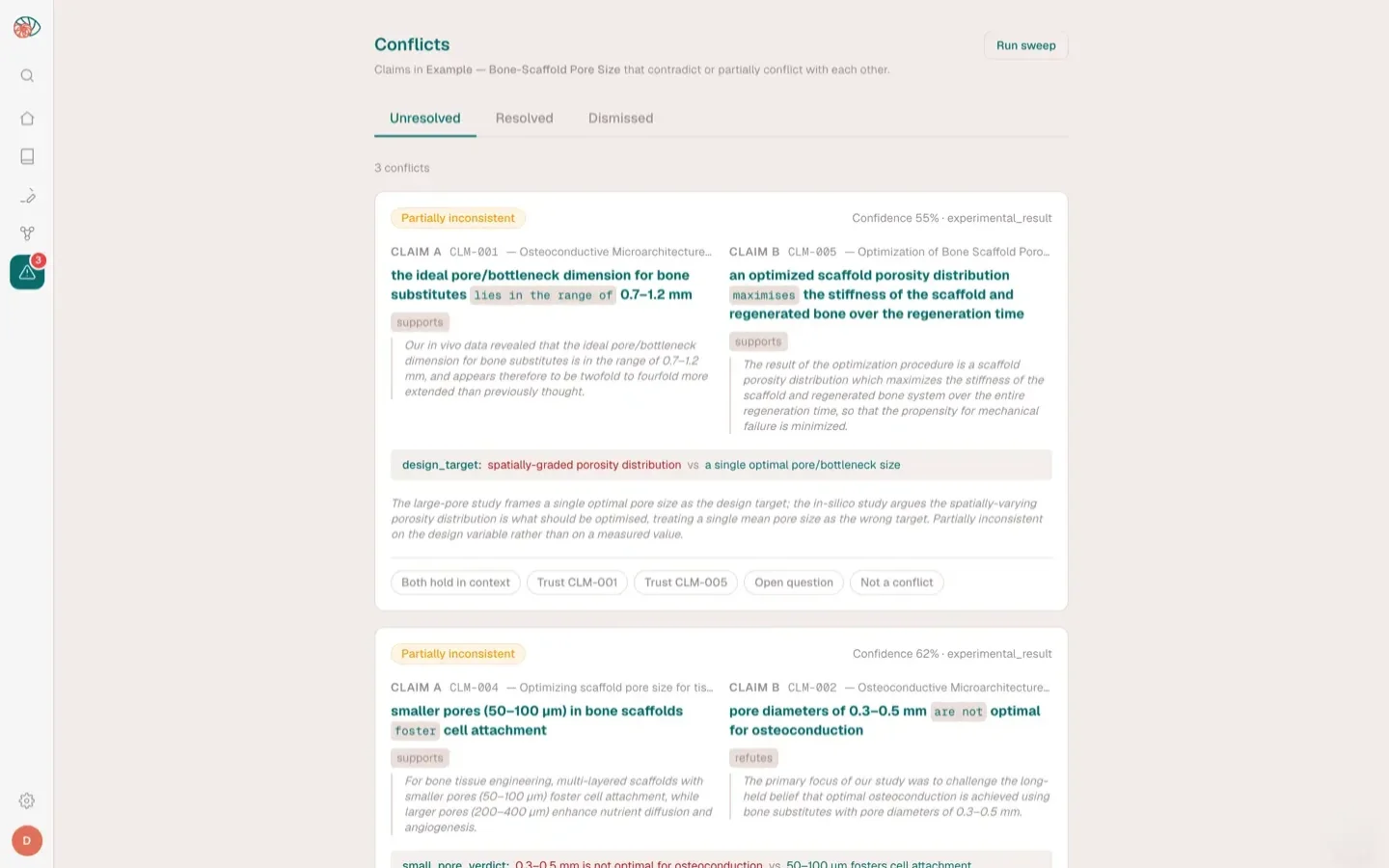
Catamaran flags conflicts across your knowledge base as first-class objects. When two claims disagree, as a published threshold and your own replication do just below, you get a conflict file that holds both claims, their comparability scores, and a place to record how you resolved it. The resolution becomes part of your decision history, where it stays auditable and citable.
differs MSA depth cutoff (≥ 64 vs ≥ 32)
Researchers don’t want fewer disagreements; they want them visible, so the judgment stays with them. Before flagging a conflict, Catamaran weighs whether two claims are even comparable on population, method, and context; an embedding would have smoothed that distinction over.
5. Catamaran is where the knowledge you accrue anywhere comes together.
Connect Claude Desktop, Claude Code, or Cursor with one token, and every conversation in those tools can search your claims, quote your sources, and show you where your own literature disagrees, grounded in the claims you have verified. When a conversation turns up something worth keeping, it proposes a claim straight back into Catamaran; the proposal lands in your review queue, where you accept or reject it, so the same approval step that governs everything else governs what your tools write. Catamaran speaks the Model Context Protocol, and the connection is one token you can revoke anytime.
Ask about your domain and the answer cites a specific claim like CLM-042, with the page and the quote behind it. Wherever you are working when you learn something, it collects in one place you own.
6. Joining the beta.
Catamaran is in private beta. We’re opening it to a small group of researchers to start and widening access over time; tell us what you work on and we’ll get you set up. Catamaran runs on your own Anthropic API key, so you control the spend, which comes to a fraction of a dollar per paper, and your text only reaches a model through a key you hold.
It’s early, so you will find rough edges, and the fastest way they get fixed is hearing about them from you. We don’t send automated waitlist mail; if we take you in, a person on the team replies to you directly.
Three questions: who you are, what you work on, and one sentence about what you’re reading right now.
7. A short tour.
Three surfaces of the actual product, taken from the live build. They carry most of the weight in a typical session.
8. What it isn’t.
Catamaran isn’t a chatbot, and we’re not adding general-purpose chat; ask a model about quantum gravity and it will cheerfully invent an answer, and that is not what we are building.
It also isn’t a notebook or a citation manager. Both categories are well-served by other tools we use ourselves. Catamaran sits between them: a reading surface that breaks papers into claims, a writing surface that grounds suggestions in those claims, and a review surface that brings up the conflicts you have collected without realizing it.
Your unpublished research is not read or trained on. Your claims live in your own private project on Catamaran’s servers; we don’t read them, train on them, or share them, and you can export your entire knowledge base to plain markdown and YAML, with every page, quote, and provenance line intact, at any time. If Catamaran disappears, your files remain.
Why now? Two things changed. Models got good enough to break a paper into structured, sourced claims that hold up when you check them, which is the capability the whole approach rests on. And AI-assisted writing made fluent, unsourced text effortless to produce, so grounding what you write in claims you have verified yourself went from a nicety to the point.